Modern medical devices increasingly require compact tubing systems capable of performing multiple functions within a limited space. Disposable multi-lumen tubing addresses this need by integrating two or more independent channels into a single polymer tube. Depending on the device design, these channels can support separate fluid pathways, aspiration, gas delivery, guidewire passage, or the routing of other functional components.
However, developing reliable multi-lumen tubing involves more than simply increasing the number of internal channels. Lumen geometry, wall thickness, dimensional tolerances, polymer properties, extrusion stability, and application-specific requirements all influence product performance. This guide explains how disposable multi-lumen tubing works, how to evaluate its materials and manufacturing processes, and what medical device manufacturers should consider when sourcing customized tubing solutions.
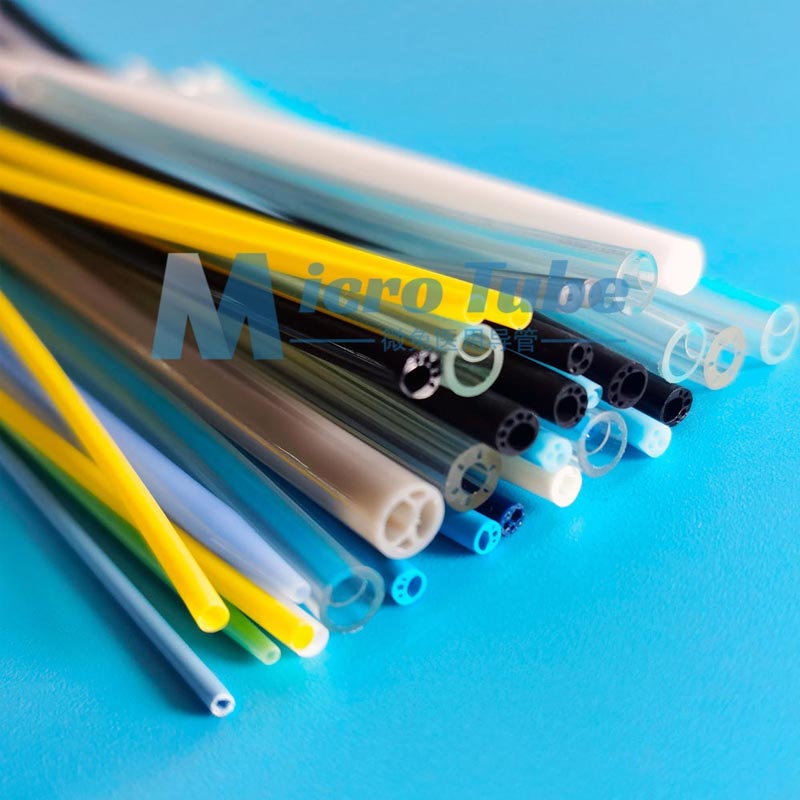
Disposable multi-lumen tubing is a specialized polymer extrusion product featuring multiple independent internal channels, commonly referred to as lumens. Unlike conventional single-lumen tubing, which provides only one continuous passage, a multi-lumen structure integrates several functional pathways into one compact tube.
Each lumen can be designed for a specific purpose. Depending on the medical device, one channel may transport liquid, another may support aspiration, and additional channels may accommodate guidewires, pressure-sensing elements, or other components.
This design is particularly useful in minimally invasive medical devices, where the available space is limited and multiple functions must be performed through a relatively small access pathway.
Disposable multi-lumen tubing is commonly developed for single-use medical devices. Its polymer construction and channel arrangement can be customized according to the intended device architecture, fluid requirements, mechanical properties, and manufacturing specifications.
A single-lumen tube provides one continuous internal passage. A multi-lumen tube contains two or more separate passages divided by internal walls. These channels can have identical or different shapes and dimensions, depending on the intended application.
For example, a medical catheter may require one channel for fluid delivery, another for aspiration, and an additional channel for a guidewire or auxiliary function. Integrating these pathways into one tube can reduce the need for several separate components.
The working principle of multi-lumen tubing is based on the independent internal pathways formed during polymer extrusion. Each channel extends along the tube and provides a designated route for fluid or other functional components.
In medical equipment, combining multiple functions into a single tube can simplify device architecture. Separate channels allow different fluids or components to be routed without requiring multiple individual tubes.
However, channel separation must be maintained throughout the required working length. Internal wall thickness, concentricity, extrusion consistency, and connection design all contribute to reliable performance.
Multi-lumen tubing can be produced in different cross-sectional arrangements. Common design considerations include:
The appropriate arrangement depends on flow requirements, available dimensions, mechanical flexibility, and the space needed for additional components.
Multi-lumen tubing is designed to solve several engineering challenges in compact medical devices. Its benefits depend on the extrusion quality, material selection, lumen configuration, and application requirements.
Supports different functional pathways within a single tubing structure.
Integrates multiple functions without requiring several separate tubes.
Allows different internal channel shapes and dimensions to match device requirements.
Supports controlled outer dimensions, internal geometry, and wall thickness.
Can be developed using different medical polymer materials according to the application.
Can be combined with hubs, connectors, reinforcement structures, and secondary processing.
One of the main advantages of multi-lumen tubing is its ability to consolidate multiple pathways into one component. This can simplify assembly and help product designers reduce unnecessary tubing connections.
Different lumens can be designed with different diameters and geometries. This makes it possible to allocate more space to a high-flow channel while maintaining smaller channels for guidewires, auxiliary functions, or other components.
When multiple functions are integrated into one extrusion, the finished device may require fewer separately routed tubes. This can simplify certain assembly operations, although the actual manufacturing benefit depends on the overall device architecture.
Material selection is a critical factor in medical tubing development. Different polymers offer different combinations of flexibility, strength, chemical resistance, transparency, processability, and mechanical recovery.
The material should be selected according to the finished device's intended use, manufacturing process, sterilization method, and applicable regulatory requirements.
TPU is widely considered for flexible medical tubing because of its elasticity, abrasion resistance, and mechanical strength. Different hardness grades can be selected to achieve different flexibility and handling characteristics.
It may be suitable for medical tubing applications requiring a combination of flexibility and durability.
Pebax is a family of polyether block amide materials offering different combinations of flexibility and mechanical performance. Different grades can be used to develop tubing with specific stiffness and handling characteristics.
It is frequently considered in catheter and interventional device development where controlled flexibility and mechanical response are important.
PA12 offers useful mechanical strength, dimensional stability, and resistance to various chemicals. It may be considered for medical tubing that requires a balance between flexibility and structural support.
FEP is a fluoropolymer known for its chemical resistance, low friction characteristics, and electrical insulation properties. It may be suitable for applications where these material properties are required.
PEEK is a high-performance engineering polymer with high mechanical strength, thermal resistance, and chemical stability. It is considered for demanding medical and industrial applications where its specific properties justify the material cost and processing requirements.
Polypropylene (PP), polyethylene (PE), PTFE, PFA, and other polymers may also be considered depending on the required application and design constraints.
| Material | General Characteristics | Potential Design Considerations |
|---|---|---|
| TPU | Flexible, elastic, abrasion-resistant | Hardness, flexibility, and chemical compatibility |
| Pebax | Adjustable flexibility and mechanical response | Grade selection and bending characteristics |
| PA12 | Mechanical strength and dimensional stability | Moisture conditioning and mechanical requirements |
| FEP | Chemical resistance and low friction | Thermal processing and joining compatibility |
| PEEK | High strength and thermal resistance | Processing temperature and cost |
| PP | Lightweight and chemical resistance | Rigidity and application-specific compatibility |
| PTFE / PFA | Fluoropolymer chemical resistance | Processing methods and joining requirements |
Material properties vary by grade and formulation. Buyers should confirm the exact material designation and evaluate its compatibility with the intended fluids, sterilization process, and device operating environment.
The manufacturing of disposable multi-lumen tubing typically involves precision polymer extrusion. Unlike simple single-lumen extrusion, multi-lumen production requires specialized tooling and accurate control of multiple internal channels at the same time.
The process begins with the customer's drawings and application requirements. Engineers evaluate the number of lumens, outer diameter, wall thickness, internal channel geometry, material, and dimensional tolerances.
Important design considerations include minimum wall thickness, separation between channels, channel symmetry, and the mechanical requirements of the finished device.
The selected polymer is prepared according to its processing requirements. Depending on the material, this may include controlled storage, drying, and preparation of colorants or functional additives.
Proper material preparation helps reduce processing defects and maintain extrusion consistency.
Molten polymer passes through a specially designed extrusion die that forms the outer profile and internal channels. Tooling geometry, melt temperature, extrusion speed, pressure, and cooling conditions all influence the final structure.
Maintaining consistent lumen dimensions is particularly important because small deviations can affect flow capacity, mechanical strength, and the space available for internal components.
After extrusion, the tubing passes through a controlled cooling process. The cooling conditions must be suitable for the polymer and product geometry to minimize deformation and maintain dimensional stability.
The tubing is inspected according to the defined product specifications. Typical inspection items include outer diameter, wall thickness, lumen geometry, surface condition, and visible defects.
Depending on the device requirements, additional processing may include cutting, tip forming, flaring, punching, printing, welding, annealing, and assembly.
These operations help transform extruded tubing into components suitable for integration into finished medical devices.
| Parameter | Reference Range |
|---|---|
| Number of Lumens | 2–10 |
| Outer Diameter (OD) | 1.00–5.00 mm |
| Wall Thickness | 0.08–1.00 mm |
| Dimensional Precision | Maximum ±0.03 mm |
| Color | Transparent or customer-specified Pantone color |
| Radiopaque Additives | Compatible with BaSO4, Bi2O3, tungsten, and other specified additives |
Note: These are published reference capabilities for multi-lumen tubing. Final dimensions, tolerances, materials, and radiopaque formulations must be confirmed for the specific product design and production agreement.
Multi-lumen tubing can support various medical device functions where several independent pathways must be integrated into a compact structure.
Minimally invasive devices often require multiple functions within a narrow insertion profile. Multi-lumen tubing can provide separate channels for fluid delivery, aspiration, guidewire passage, or other auxiliary functions.
Its compact construction can help device designers manage limited internal space while maintaining functional separation.
Gastrointestinal devices may require multiple pathways for fluid management, drainage, or other application-specific functions. Multi-lumen tubing can be designed to accommodate different channels within one integrated structure.
Channel dimensions and polymer flexibility should be evaluated according to the intended anatomical pathway and device design.
Some infusion-related device architectures require multiple separate fluid pathways. Multi-lumen tubing can provide independent channels for different fluid routes, subject to appropriate connector design and validated fluid separation.
Catheter-based ablation systems may require channels for irrigation, electrical components, temperature sensing, or other functions depending on the device architecture.
A customized multi-lumen structure can help organize these functional pathways within a compact catheter body.
Interventional devices may need internal pathways for guidewires, fluids, and other functional components. Multi-lumen tubing can be designed to support these requirements while balancing flexibility, pushability, and dimensional constraints.
Beyond the applications listed above, multi-lumen tubing may be considered for specialized diagnostic instruments, medical delivery systems, and other disposable device assemblies that require multiple internal pathways.
Choosing the right tubing requires a clear understanding of the finished device's technical requirements. An unsuitable design may lead to inadequate flow, channel deformation, excessive bending resistance, or difficulties during device assembly.
Begin by identifying how many independent pathways the device needs. Each additional lumen affects the available space, wall thickness, extrusion complexity, and overall mechanical properties.
Use the minimum number of channels necessary to perform the intended functions without compromising device performance.
The outer diameter must fit the intended device profile, while each internal channel must provide sufficient space for the required fluid flow or functional component.
Consider the relationship between lumen diameter, internal wall thickness, outer wall thickness, and overall tube dimensions.
For fluid-carrying channels, determine the required flow rate, fluid viscosity, pressure conditions, and acceptable pressure drop.
For a simple circular channel under ideal laminar flow conditions, the Hagen–Poiseuille relationship illustrates how flow depends strongly on the internal radius:
Where:
This equation applies to idealized laminar flow in a straight circular tube. Actual multi-lumen performance requires testing under the intended operating conditions.
Consider the required flexibility, tensile performance, chemical resistance, thermal stability, and sterilization compatibility. The polymer should be suitable for the entire intended manufacturing and usage process.
Small changes in lumen dimensions can affect flow and mechanical performance. Buyers should define acceptable tolerances for outer diameter, internal dimensions, wall thickness, and channel separation.
Some interventional medical devices require radiopaque materials to improve visibility under medical imaging. Depending on the product design, materials such as barium sulfate, bismuth compounds, or tungsten may be incorporated into the polymer formulation.
The radiopaque additive concentration should be evaluated alongside mechanical properties, extrusion stability, and the required imaging performance.
The selected material and finished tubing assembly must be compatible with the intended sterilization process, such as ethylene oxide, gamma irradiation, or another validated method.
Material changes after sterilization, including discoloration, embrittlement, deformation, or changes in mechanical performance, should be assessed through appropriate testing.
| Selection Factor | Questions to Consider | Impact on the Product |
|---|---|---|
| Lumen Quantity | How many independent channels are required? | Functional integration and structural complexity. |
| Outer Diameter | What is the available device space? | Device profile and compatibility. |
| Lumen Size | What flow or component clearance is needed? | Flow performance and functionality. |
| Material | What flexibility and chemical resistance are required? | Mechanical and chemical performance. |
| Wall Thickness | What structural strength is needed? | Channel separation and deformation resistance. |
| Sterilization | Which sterilization method will be used? | Material stability and device validation. |
| Radiopacity | Is imaging visibility required? | Material formulation and imaging performance. |
For disposable medical tubing, consistent product quality is essential. Dimensional variation, channel blockage, surface defects, or material inconsistencies can affect downstream assembly and finished device performance.
A systematic quality control approach should address both the extrusion process and the final product requirements.
Outer diameter, lumen dimensions, wall thickness, and channel separation should be checked against approved drawings and tolerances. Suitable measurement methods may include optical inspection, cross-sectional analysis, and other validated dimensional measurement techniques.
The tubing should be inspected for scratches, contamination, bubbles, discoloration, deformation, and other visible defects that may affect processing or intended use.
Each channel should be checked for continuity and unintended blockage. Where channel isolation is important, suitable testing should confirm that the internal walls maintain separation under defined conditions.
Depending on the application, testing may include tensile strength, elongation, flexibility, bending behavior, compression resistance, and connection performance.
Documented material identification, production records, inspection results, and batch traceability help support quality investigations and manufacturing consistency.
Producing multi-lumen tubing involves several technical challenges because multiple internal channels must maintain their intended geometry throughout the extrusion process.
Possible causes: Unstable extrusion conditions, tooling inaccuracies, uneven cooling, or inconsistent material flow.
Practical solutions: Optimize die design, stabilize processing parameters, and introduce appropriate in-process dimensional inspection.
Possible causes: Insufficient wall thickness, unsuitable material properties, excessive process variation, or mechanical stress.
Practical solutions: Review channel geometry, material selection, extrusion conditions, and the structural requirements of the finished tube.
Possible causes: Improper tooling alignment, material contamination, or unstable extrusion and cooling conditions.
Practical solutions: Improve material preparation, tooling maintenance, process monitoring, and lumen continuity inspection.
Possible causes: Incorrect polymer grade, excessive wall thickness, or an unsuitable lumen arrangement.
Practical solutions: Evaluate alternative material grades, revise the cross-sectional design, and test bending behavior using representative samples.
Possible causes: Variations in raw material, equipment settings, cooling conditions, or production control.
Practical solutions: Establish controlled process parameters, maintain equipment, document production conditions, and monitor batch inspection data.
Possible causes: Incompatible connectors, unsuitable tube-end geometry, or inadequate dimensional coordination.
Practical solutions: Review the complete assembly drawing and evaluate secondary processing such as tip forming, flaring, punching, welding, and printing during the design stage.
Standard tubing products may not meet every medical device requirement. Custom extrusion allows the tubing structure to be developed around the specific needs of the finished device.
A specialized manufacturer can evaluate different lumen quantities, shapes, dimensions, and wall configurations according to the approved technical drawings.
Medical polymer tubing requires careful consideration of material grades and processing characteristics. Technical support can help customers evaluate suitable TPU, Pebax, PA12, FEP, PEEK, PP, and other polymer options.
Beyond extrusion, certain projects require additional operations, including:
Medical device development often involves several stages, from initial design evaluation to sample production, verification, process validation, trial production, and mass manufacturing.
Working with a supplier capable of supporting multiple development stages can help reduce coordination difficulties and improve the transition from prototype to production.
Ningbo Micro-tube Polymer Materials Co., Ltd. specializes in precision medical polymer tubing and customized catheter manufacturing. The company provides extrusion and secondary processing services for medical device manufacturers seeking application-specific tubing solutions.
Its material capabilities include TPU, Pebax, PA12, PA11, FEP, ETFE, PTFE, PEEK, PP, and other polymer materials. Its multi-lumen tubing development supports customized channel configurations and dimensional requirements.
According to its published product information, the company offers multi-lumen structures with 2 to 10 channels, outer diameters from 1.00 mm to 5.00 mm, and wall thicknesses from 0.08 mm to 1.00 mm, with a stated maximum dimensional precision of ±0.03 mm for the listed product range.
The company also provides secondary processing and CDMO/ODM-related services, helping customers coordinate tubing development, processing, and product manufacturing requirements.
Providing detailed technical information enables the manufacturer to evaluate tooling feasibility, material suitability, production requirements, and expected development costs more accurately.
Disposable multi-lumen tubing is a polymer tube containing two or more independent internal channels. It is designed to support multiple functions, such as fluid delivery, aspiration, guidewire passage, or other device-specific pathways within one integrated structure.
Its main advantages include functional integration, compact construction, independent internal channels, customized geometry, and the potential to reduce the number of separate tubing components in a medical device.
The number depends on the product design and manufacturing capabilities. Ningbo Micro-tube Polymer Materials Co., Ltd. lists multi-lumen configurations ranging from 2 to 10 channels for its published product range.
Common material options include TPU, Pebax, PA12, PA11, FEP, ETFE, PTFE, PEEK, PP, and other medical polymer materials. The appropriate choice depends on flexibility, mechanical requirements, chemical compatibility, and sterilization conditions.
Yes. Customized tubing can be developed according to customer drawings and application requirements, including lumen quantity, channel geometry, outer diameter, wall thickness, material, color, and dimensional tolerances. Technical feasibility should be confirmed with the manufacturer.
There is no universal standard size. The published reference range for Ningbo Micro-tube's multi-lumen tubing is 1.00 mm to 5.00 mm in outer diameter, with wall thicknesses from 0.08 mm to 1.00 mm.
Radiopaque additives help improve the visibility of selected medical device components under appropriate imaging methods. Materials such as barium sulfate, bismuth compounds, and tungsten may be considered depending on the required imaging performance and material formulation.
Yes. Multi-lumen tubing can be used in catheter-related applications that require multiple independent pathways. Its suitability depends on the catheter design, required mechanical properties, fluid functions, and applicable device validation requirements.
Precision polymer extrusion is commonly used. Specialized dies form the outer profile and internal channels simultaneously. The process is followed by controlled cooling, dimensional inspection, cutting, and any required secondary processing.
Sterilization compatibility depends on the polymer grade, additives, tubing structure, and sterilization method. The finished product must undergo appropriate compatibility assessment and validation for its intended medical application.
Buyers should provide product drawings, lumen quantity, outer diameter, channel dimensions, wall thickness, polymer material, tolerance requirements, application details, secondary processing needs, and estimated order quantity.
Some specialized medical tubing manufacturers provide integrated services covering design evaluation, custom extrusion, sample production, secondary processing, product verification, trial production, and OEM manufacturing. The available scope should be confirmed for each project.
Disposable multi-lumen tubing provides an effective way to integrate multiple functional pathways into a single compact polymer structure. Its customized channel geometry, material flexibility, and precision extrusion process make it valuable for a wide range of medical device applications, particularly where space, fluid management, and functional integration are important.
However, achieving reliable performance requires careful coordination of lumen dimensions, wall thickness, material selection, extrusion stability, and finished-device requirements. Buyers should also consider sterilization compatibility, quality control, traceability, and downstream assembly when evaluating a tubing supplier.
For medical device manufacturers and product developers, working with an experienced precision extrusion partner can help simplify custom tubing development and support the transition from initial concepts to production-ready components.
Ningbo Micro-tube Polymer Materials Co., Ltd. specializes in precision medical polymer tubing, customized multi-lumen extrusion, and catheter-related manufacturing solutions.
Whether you need a customized multi-lumen structure, specific polymer materials, tight dimensional tolerances, or additional catheter processing services, our team can help evaluate your project requirements.
Have a new medical device project or sourcing requirement? Contact us today to discuss your drawings, technical specifications, and production needs. Let us work together to develop a suitable multi-lumen tubing solution for your application.
Contact Us for a Custom Solution-